Securing International Customs Clearances: Understanding the EORI Number and HS Code Duo
Comprehensive guide to customs compliance: master the EORI number and HS code to secure your declarations, prevent border blocks, and streamline your supply chain.
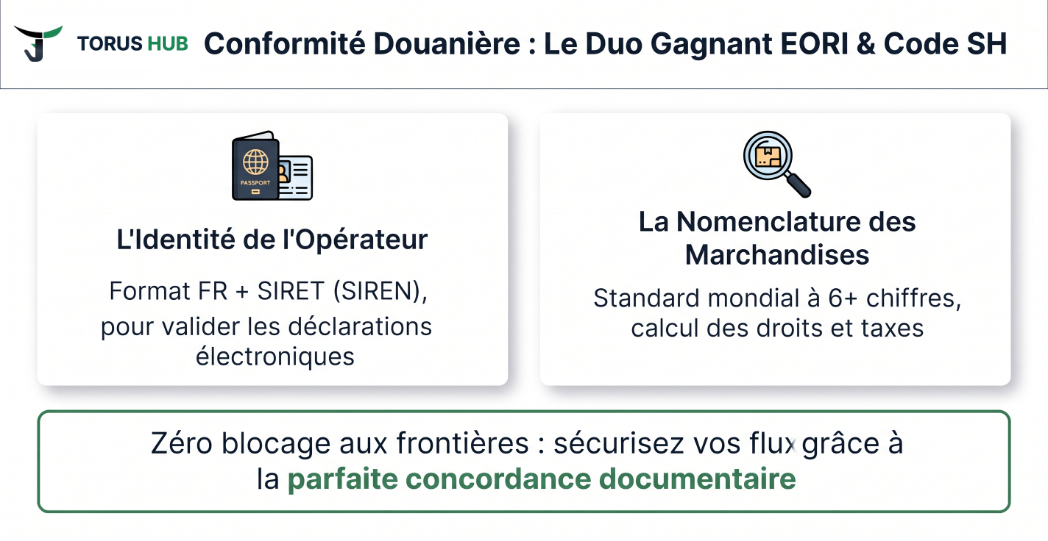
In international trade and cross-border freight, the slightest documentary approximation can trigger critical delays, port demurrage fees, or customs blocks. Two identifiers sit at the heart of customs compliance: the EORI number (Economic Operators Registration and Identification) and the HS code (Harmonized System). Mastering and linking them is essential for any shipper, importer, or exporter looking to streamline their supply chain.
The EORI Number: The Customs Passport for Economic Operators
Created by Regulation (EC) No 312/2009, the EORI number is a unique identifier assigned to economic operators performing customs formalities within the EU. In France, established operators use FR + SIRET. Without a valid EORI, no electronic customs declaration can be processed, resulting in immediate cargo detention.
- Free online application via SOPRANO EORI on douane.gouv.fr
- Unique identifier valid across all EU customs operations
- Online validation available via the European Commission service
The HS Code: The Universal Commodity Nomenclature
Developed by the World Customs Organization (WCO), the Harmonized System classifies goods using a standardized 6-digit tree structure applied by over 190 administrations, covering 98% of world trade. It determines applicable customs duties, taxes, restrictions, and embargoes.
- First 2 digits: Chapter
- First 4 digits: Heading
- First 6 digits: Subheading (global common level)
- National/EU extensions (TARIC): Specific duties and regulatory measures
Risks of Misclassification or Omission
An incorrect HS code or EORI exposes companies to severe financial and operational consequences, including customs adjustments, penalties, retroactive duties (with a statute of limitations up to 10 years for criminal cases), physical inspections, and demurrage costs.
- Standard notification period: 3 years (up to 10 years for criminal fraud)
- Critical port demurrage and warehousing costs
- Supply chain paralysis due to document discrepancies
Best Practices for Reliable Declarations
Implement these core practices to secure your customs operations:
- 1. Anticipate EORI registration prior to shipments.
- 2. Rigorously audit HS codes and secure Binding Tariff Information (BTI) for sensitive goods.
- 3. Centralize and harmonize documentation across invoices, packing lists, and transport documents.
- 4. Extend archive retention beyond the mandatory 3-year minimum.
- 5. Validate partners' EORI numbers.
- 6. Prepare early for the upcoming HS 2028 revision.
Source(s) & Références :
- French Customs (DGDDI) — EORI number and registration procedure / RITA tariff encyclopedia
- World Customs Organization (WCO) — HS Nomenclature 2028 edition and Harmonized System overview
- Regulation (EU) No 952/2013 (Union Customs Code) — Article 103: Customs debt statute of limitations and litigation